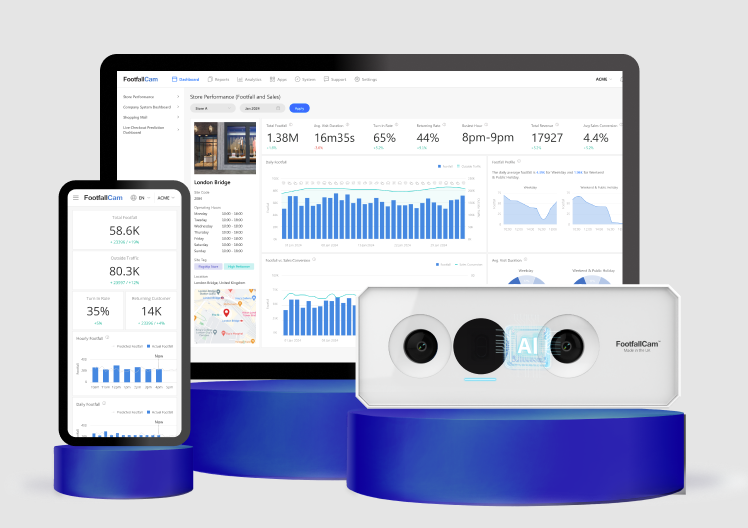
To stay relevant in a developing retail industry, the pivot towards data-driven methods is going fast. In a time when customer expectations are high and competitive pressure is constant, retailers need accurate insights to optimize store operations and boost customer experiences. Among them are two technologies with an essential role in this process: the footfall counter and retail analytics software.
The footfall counter aids the retailers by counting the number of visitors going in and out of a store. Retail analytics software is a program that helps in interpreting this data to find meaningful insights regarding customer behavior, store performance, operational efficiency etc. Together, these technologies equip retailers with the ability to make data-driven decisions that enhance growth and operational performance.
This blog discusses how integrating a footfall counter with retail analytics software is revolutionizing data-driven retail and enabling businesses to supercharge their store performance.
What is Data-Driven Retail?
Data-driven retail is the practice of utilizing measurable data and analytics to inform business decisions. Retailers mine real-time data for insights into customers, stores and operational strategies instead of relying on assumptions and static information.
Footfall counter: Footfall counter helps store owners to get visitor data by counting the number of people visiting a store. But blindly looking at raw numbers doesn’t yield much in the way of actionable insights. This is the point where retail analytics software becomes a great asset.
Retail analytics software consolidates visitor traffic information into useful insights that retailers can apply towards enhancing its strategy and operations by analyzing data captured from a footfall counter.
Quantifying Customer Footfall with Metrics Counters
One of the key metrics for retail performance is customer traffic. Footfall counter allow retailers to monitor the flow of visitors into a store during various periods of time in a day, week or month.
Looking at this data via retail analytics software, the retailers will see these trends:
- Peak shopping hours
- High and low traffic days
- Seasonal trends in customer visits
- 1 in-store customer traffic frequency
This gives retailers insight on when their store is busiest so they can plan around it.
From Raw Data to Meaningful Insights
The essence of data-driven retail is in the transition from raw information to actionable insights. While a footfall counter produces visitor data, retail analytics software analysis and organizes the information in a comprehensive manner.
Retail analytics software helps the retailer to analyze through dashboards, reports and visual analytics:
- Traffic trends
- Store performance metrics
- Customer engagement levels
- Operational efficiency indicators
Integrating a footfall counter and retail analytics software provides retailers with a complete view of how their stores perform and interact with the retail environment.
Improving Conversion Rate Performance
Calculating conversion rates is one of the biggest advantages for retailers that integrate a footfall counter with retail analytics software. The conversion rate means the proportion of shop and store visitors who buy something.
For example, a footfall counter measures the number of visitors entering a store and retail analytics software compares this metric against sales.
For example:
For example, if the footfall of a shop is pretty high but sales figures are poor, then it can indicate that there might be issues like misplacement of products or price keep-lot concerns.
If both visitors and sales are increasing, it indicates the store is effectively converting customers.
Retail analytics software provides the ability to analyse conversion data that helps retailers find opportunities for better sales performance.
See also: Understanding Syringe Needle Sizes and Their Role in Healthcare
Optimizing Staffing and Workforce Management
Customer service is one of the most important aspects of any business, efficient staff management will guarantee a good customer experience. Without the right data, retailers risk over-staffing or under-staffing their stores, resulting in costly inefficiencies or poor customer experiences.
Retail analytics software can use this information to guide staffing decisions, which a footfall counter can help identify the busiest times.
This information can help retailers to:
- Weekly Staff Schedule during the peak shopping hours
- Optimize labor during low traffic hours
- Deliver improved support during peak times
Retailers can balance their workforce management and improve the efficiency of their operations by operating major insights from a footfall counter and retail analytics software.
Improving Store Design and Product Location
The design of the store helps determine how customers experience shopping. “Retailers need to create stores that invite visitors; walk around freely and browse products.
A footfall counter can be used to track the flow of visitors into a store and retail analytics software use this data to find high-traffic areas in stores.
With these insights, retailers can:
- Keep popular products at eye level
- Make aisle navigation and reaching products easier
- Set up promotional displays in high-traffic areas
Using the data from a footfall counter, retailers can enhance their customer experience and sales capture by optimizing their store layouts.
How to Measure the Impact of Marketing Campaigns
This is a marketing campaign to bring the customer base out and visit their stores. However, in order to measure their effectiveness you need accurate traffic data.
An individual can take note of footfall opportunities with a foot-fall counter which gives them an insight into the differences in visitor traffic during promotional campaigns. By analyzing this data with retail analytics software, retailers can assess the grade of promotions and advertising activities.
Retailers can determine:
- Which campaigns drive the most in-store visits
- Which marketing channels drive footfall
- How promotions influence customer behavior
Such insights allow retailers to optimize their marketing strategies and spend on campaigns that yield tangible results.
Supporting Multi-Store Performance Analysis
For retailers managing more than one location, they need performance metrics that are similar across all their locations. A foot traffic counter will provide visitor numbers per location, and retail analytics software allows you to compare stores.
Retailers can analyze:
- Visitor traffic by location
- Conversion rates across stores
- Regional shopping patterns
- Performance of local marketing initiatives
Retailers can close the performance gaps with retail analytics software, allowing them to identify top performing stores and replicate best practices across their network.
Creating Smarter Retail Environments
Smart stores are the future of retail, blending physical shopping with digital smarts. Footfall counter and retail analytics software is an important part of this transformation process.
Retailers use these technologies to understand customer behavior, optimize store operations, and deliver personalized shopping experiences.
Conclusion
Data is the new retail: As data-driven approaches gain traction in the retail space, from big box stores to small independent retailers A footfall counter gives information about actual visitor traffic data, and retail analytics software turns this data into actionable insights.
Combined, these technologies enable retailers to gain insights about customer behavior, fine-tune staffing levels and store layouts, and analyze marketing effectiveness. Footfall Counter Retail Analytics Software Retailers Can Operate Efficiently and Make Smarter Decisions.
By integrating data-driven tools such as footfall counter systems and retail analytics software, businesses in the industry can adapt to rapid changes in consumer behavior while gaining valuable insights that will enhance their business decision-making process.
FAQs
1. What is a footfall counter in retail?
In smart retail, a footfall counter is an electronic device that counts the number of people walking into or out of a store — allowing retailers to gauge peak periods for customer traffic.
2. How do retail analytics software interact with footfall counters?
Retail analytics software analyzes the visitor data captured by a footfall counter to provide insights regarding customer behaviour, traffic trends and store performance.
3. Why is data-driven retail important?
Modern data-driven retail enables businesses to make intelligent decisions by generating real-time insights from technologies such as a footfall counter system and retail analytics software.
4. How footfall counters can help increase sales?
Yes, a footfall counter collects visitor traffic data and gives retailers insights into conversion rates which help towards decision making to make their sales process efficient.
5. In what ways does retail analytics software enhance store management?
Retail analytics software that measures footfall data assists retailers in optimizing employee scheduling, assessing marketing efforts, and enhancing visits to a store.
6. Are footfall counters good for small retail businesses?
Yes, even a small retail store can have an impact with footfall counter and use in conjunction with its retail analytics software because the two are utilized to gain insight which is clear for any operation of a store that is efficient.